

It’s January 2026. Your website gets 50,000 monthly visits. But check your logs more carefully. Half of those visits aren’t from humans—they’re from AI agents. Gemini. ChatGPT. Claude. Perplexity. They’re visiting your site to answer questions about your products, not to drive traffic to your site.
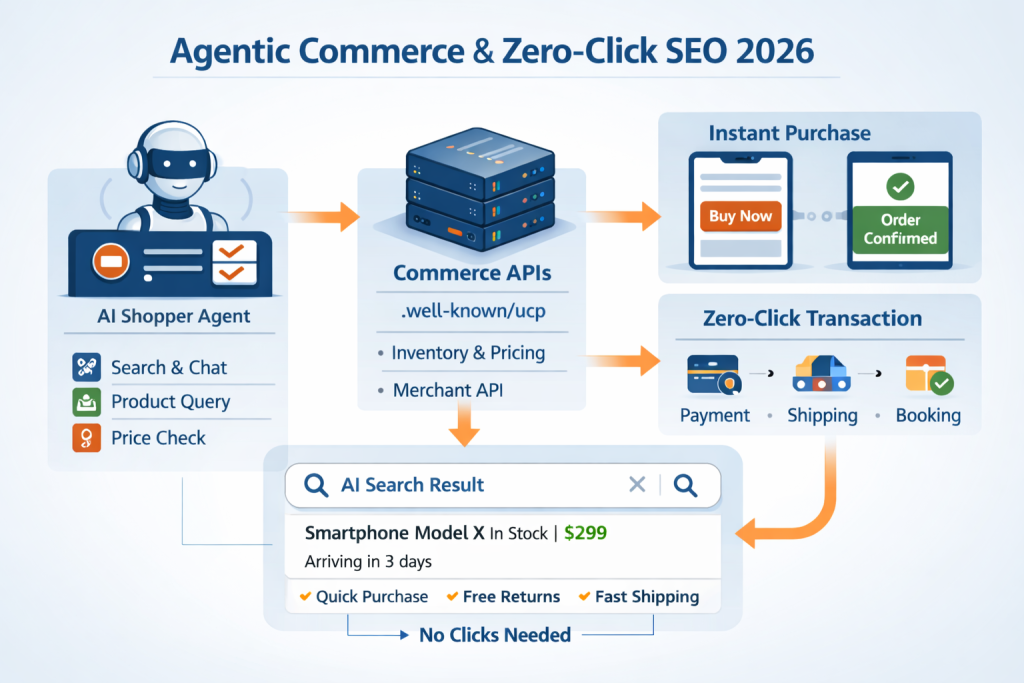
Here’s the uncomfortable truth: if you haven’t implemented UCP or ACP, your data is invisible to these agents. Your competitors’ products appear in ChatGPT’s shopping recommendations. Yours don’t. Your product feeds exist, but they’re locked behind human-readable interfaces. Agents can’t parse them. This is Agent Invisibility—and it’s worse than traditional zero-ranking because it means you’re losing sales at the discovery layer before users even know you exist.
The Thesis: Agent Invisibility isn’t a ranking problem—it’s an architectural problem. If you don’t implement UCP (Universal Commerce Protocol) or ACP (Agentic Commerce Protocol), you suffer from ACO Invisibility. Your SEO works fine. Your traffic looks stable. Your ACO is zero. By 2030, 25% of global e-commerce will be driven by agentic systems. The merchants who adapted their infrastructure will own that market share. The rest will be increasingly invisible.
The industry is currently split—but not the way you think. On January 11, 2026, Google launched the Universal Commerce Protocol (UCP), an open standard co-developed with Shopify, Etsy, Wayfair, Target, and 20+ other partners. Simultaneously, OpenAI and Stripe’s partnership (which launched ACP in September 2025) continues to power ChatGPT’s Instant Checkout feature, now used by 45% of U.S. consumers in the past month.
Google UCP establishes a shared language between AI agents and commerce systems. It works with existing standards (Agent2Agent, Agent Payments Protocol, Model Context Protocol) and removes the need for custom integrations. The protocol is modular and extensible, meaning merchants choose which capabilities they support: inventory discovery, fulfillment calculations, returns processing, loyalty integration.
UCP is built on four foundational layers: the Merchant Center Graph (your product feeds become queryable data), Schema.org Markup (JSON-LD structures agents parse without guessing), Multiple Transport Bindings (REST APIs, MCP, Agent-to-Agent communication), and Agent Discovery (the /.well-known/ucp endpoint lets agents dynamically discover what your business can do).
OpenAI-Stripe ACP, by contrast, is specialist in nature. It focuses narrowly on conversational commerce and delegated checkout within ChatGPT. It’s not trying to be a universal transport layer. Instead, it’s optimized for a single user experience: the user asks ChatGPT for a product recommendation, the agent finds it via your API, and the user completes payment without leaving the chat interface.
ACP’s architecture relies on Stripe’s Payment Rails (tokenized payments via Shared Payment Tokens), REST-only Transport (no MCP, no A2A), Centralized Onboarding (merchants apply directly to OpenAI), and Tight UX Integration (checkout is polished because it’s designed for one interface).
UCP doesn’t replace ACP. It complements it.
Google’s advantage: It already hosts product feeds through Merchant Center. The company can give away UCP as infrastructure because the more merchants implement it, the more agents query Google’s Shopping Graph, the more Google’s data advantage compounds. When a user asks Gemini “what’s the best suitcase,” Gemini queries Google’s indexed inventory. Google wins.
OpenAI’s limitation: It has no native product index. It’s entirely dependent on merchants opting in. ChatGPT can’t automatically surface Amazon products because Amazon blocks OpenAI crawlers entirely—zero Amazon inventory appears in ChatGPT Shopping. OpenAI must grow merchant-by-merchant, and it must partner with Stripe to monetize transactions.
Verdict: A hybrid approach is necessary for total coverage. Merchants that implement only UCP reach users in Google Search and Gemini but miss the 45% of consumers who shop via ChatGPT. Merchants that implement only ACP reach ChatGPT users but forfeit Google’s high-intent search traffic. Optimal strategy: implement both. The technical overhead is justified because you’re addressing two distinct user behaviors—search-driven discovery vs. conversational commerce.
Agent readiness is not binary. Your store doesn’t go from “agent-invisible” to “agent-native” in a single migration. Instead, it progresses through five distinct levels. Understanding which level you’re at determines your next investment priority.
What it means: Your business identity is verifiable to agents. At this level, agents must be able to confirm: Is this merchant real? Is it authorized to sell these products? Can I trust the data coming from this entity?
Technical requirements: Google Business Profile (current, verified, with phone, address, business hours), Merchant Center Account (active, in good standing, no policy violations), Brand Verification (your brand is confirmed in your Merchant Center feed), and Domain Ownership (domain verified; SSL certificates valid).
Implementation time: 1–2 weeks.
What it means: Your product data moves from static feeds to real-time APIs. Traditional product feeds are XML files uploaded daily or weekly—snapshots. An agent queries your inventory at 3 PM; the feed was last updated at 2 AM. If stock changed at 2:30 PM, the agent gets stale data and loses trust.
Real-time APIs solve this. Instead of uploading XML, you expose a REST endpoint that agents query on-demand. Your inventory, pricing, and availability are current.
Technical requirements: Product API Endpoint returning current stock and price, Real-time Inventory Sync from your WMS/ERP, SKU/GTIN Consistency across all channels, and Variant Handling with unique identifiers.
Implementation time: 3–6 weeks.
What it means: You publish a machine-readable service manifest that agents can discover. Agents don’t know your site in advance. They need a standardized way to ask: “What can this business do for me? What APIs do you expose? What payment methods do you support? What regions do you ship to?”
Your answer lives in /.well-known/ucp—a JSON file at your domain root that answers all of these questions.
Technical requirements: UCP Manifest File published at https://yoursite.com/.well-known/ucp, Capabilities Declaration, Service Endpoints, Agent Allow List, and Payment Configuration.
Implementation time: 1–2 weeks.
What it means: You expose API routes that agents use to execute purchases. At this level, your backend becomes an agent-ready commerce system. Instead of agents navigating your UI, they call your APIs directly.
Required endpoints include: GET /ucp/v1/inventory/{sku} (real-time stock check), POST /ucp/v1/cart/validate (cart validation), POST /ucp/v1/checkout/create (initialize checkout), and POST /ucp/v1/checkout/complete (finalize payment).
Technical requirements: Stock Check Logic with accurate backorder handling, Shipping Calculation triggered by valid address, Tax Calculation, Payment Tokenization (agents receive tokenized handles, not raw card data), Comprehensive Error Handling, and Response Latency of <200ms.
Implementation time: 4–8 weeks.
What it means: Your system can negotiate with agents dynamically—prices, fulfillment options, and contract terms shift based on agent context. At Level 5, your store doesn’t just process orders. It negotiates with agents on behalf of customers.
B2B procurement agents can handle complex pricing matrices, tiered discounts, and negotiated terms that human users can’t. Agents representing corporate entities should access corporate pricing.
Implementation time: 8–12 weeks.
/.well-known/ucp ConfigurationAgents look for this file first. If you don’t publish a valid UCP manifest, agents can’t discover your store programmatically.
The file must be published at: https://yoursite.com/.well-known/ucp and must be valid JSON and publicly accessible. Here’s a production-ready example:
{
“ucp”: “2026-01-11”,
“services”: [
{
“service_type”: “com.google.shopping.merchant”,
“version”: “2026-01-11”,
“spec”: “https://ucp.dev/services/shopping/rest.openapi.json”,
“rest”: {
“schema”: “https://ucp.dev/services/shopping/rest.openapi.json”,
“endpoint”: “https://api.yoursite.com/v2”
},
“mcp”: {
“schema”: “https://ucp.dev/services/shopping/rest.openapi.json”,
“endpoint”: “https://mcp.yoursite.com/messages”
}
}
],
“capabilities”: [
{
“namespace”: “com.google.shopping”,
“capability”: “shopping”,
“version”: “2026-01-11”,
“spec”: “https://ucp.dev/services/shopping/rest.openapi.json”,
“schema”: “https://ucp.dev/services/shopping/shopping.schema.json”,
“config”: {
“supported_currencies”: [“USD”, “EUR”, “GBP”],
“supported_regions”: [“US”, “CA”, “GB”, “DE”, “FR”],
“return_policy”: {
“days”: 30,
“method”: “ReturnByMail”,
“fees”: “FreeReturn”
}
}
}
],
“agent_allow_list”: [
“https://gemini.agent.google.com”,
“https://chatgpt.openai.com”,
“https://claude.anthropic.com”
],
“authentication”: {
“type”: “oauth2”,
“token_endpoint”: “https://auth.yoursite.com/oauth/token”,
“scopes”: [“shopping:read”, “checkout:write”, “inventory:read”]
},
“payment_handlers”: [
{
“handler_id”: “stripe”,
“handler_type”: “https://stripe.com”,
“public_key”: “pk_live_your_public_key”
}
]
}
Deploy this file with a long TTL (86400 seconds / 24 hours). Agents cache it aggressively.
Your backend must expose four core endpoints forming the agent-checkout lifecycle.
GET /ucp/v1/inventory/{sku}): Agents query this before recommending a product. Response time must be <200ms. Return accurate stock level, availability status, and pricing.
POST /ucp/v1/cart/validate): Agents test whether a cart is valid before committing payment. Validate address, calculate tax, confirm items in stock. Return full cart state including fulfillment options.
POST /ucp/v1/checkout/create): Agents initialize a checkout session. Create an order record, allocate inventory temporarily (hold for 30 minutes), return session ID.
POST /ucp/v1/checkout/complete): Agents finalize payment. Process payment via Stripe or your provider. If successful, create order and send confirmation.
How do you prevent scrapers and bots from abusing your API while allowing legitimate agents?
Issue access tokens that expire. Agents include tokens in API calls.
You issue each authorized agent an API key and secret. Agents sign every request with HMAC-SHA256.
Recommendation: Use API Key + HMAC for agent-to-merchant traffic. It’s faster, requires no session state, and is cryptographically sound.
Your API is necessary. Your schema is fundamental. Agents parse schema to understand what you’re selling, how it ships, and what the business terms are.
Most merchants implement basic Product schema. Agents ignore this. It’s insufficient. You need context: return policies, shipping costs, warranty, allergen info, availability windows, and most importantly, actionable next steps.
The Complete Agent-Ready Product Schema – Sample
{
“@context”: “https://schema.org”,
“@type”: “Product”,
“name”: “Premium Wireless Headphones”,
“description”: “Premium wireless headphones with noise cancellation and long battery life.”,
“sku”: “SKU-12345”,
“gtin”: “5901234123457”,
“brand”: {
“@type”: “Brand”,
“name”: “Your Brand Name”
},
“image”: [
“https://www.yoursite.com/images/premium-wireless-headphones.jpg”
],
“offers”: {
“@type”: “Offer”,
“price”: 149.99,
“priceCurrency”: “USD”,
“availability”: “https://schema.org/InStock”,
“shippingDetails”: {
“@type”: “OfferShippingDetails”,
“shippingDestination”: {
“@type”: “DefinedRegion”,
“addressCountry”: “US”
},
“shippingRate”: {
“@type”: “MonetaryAmount”,
“currency”: “USD”,
“value”: 9.99
},
“deliveryTime”: {
“@type”: “ShippingDeliveryTime”,
“transitTime”: {
“@type”: “QuantitativeValue”,
“minValue”: 3,
“maxValue”: 5,
“unitCode”: “DAY”
}
}
},
“hasMerchantReturnPolicy”: {
“@type”: “MerchantReturnPolicy”,
“applicableCountry”: [“US”, “CA”],
“merchantReturnDays”: 30,
“returnMethod”: “https://schema.org/ReturnByMail”,
“returnFees”: “https://schema.org/FreeReturn”
}
}
}
Key additions for agents: inventoryLevel (exact stock—agents prioritize merchants with inventory), shippingDetails (complete shipping matrix), hasMerchantReturnPolicy (return window, method, fees—agents evaluate risk), and potentialAction (the actionable URL agents call to initiate purchase).
Traditional SEO metrics—impressions, clicks, CTR—are obsolete for agentic commerce. You need new metrics.
Definition: Percentage of your API calls that originate from verified AI agents (not bots, not humans, not scrapers).
Definition: Average response time for agent API calls. Benchmark: <200ms. Agents prioritize fast merchants.
PSOS is how much of the “prompt space” your brand occupies in LLM responses. Think of it as the agentic equivalent of first-page ranking, but measured across ChatGPT, Gemini, Claude, and Perplexity simultaneously.
Formula: PSOS = (Breadth × Depth × Resilience) + Sentiment Overlay – Decay Adjustment
Components:
Benchmark range: 0–100. 75–90 = Category Leader (consistently top 3); 90–100 = Dominant (default recommendation).
The irony of the zero-click era is that the web isn’t becoming less important—it’s becoming invisible to humans while becoming hypervisible to machines. For the past 25 years, success meant ranking on Google’s first page. Now it means being accessible to agents that Google, OpenAI, Anthropic, and Perplexity send to your site 24/7.
Agent Invisibility is the new zero-ranking. You can have perfect organic SEO, clean code, and strong brand authority. But if your product data isn’t machine-readable and your API isn’t agent-ready, you’re invisible where 25% of commerce happens.
The merchants who adapted their infrastructure in 2026 will own disproportionate market share by 2030. The rest will gradually fade from agentic discovery. It’s not aggressive competition; it’s architectural Darwinism. Your next competitive moat isn’t your ad spend. It’s your ability to be discovered and transacted with autonomously.
Weeks 1–2: Assessment
Weeks 3–4: Quick Wins
/.well-known/ucp file with basic capabilitiesMerchantReturnPolicy and ShippingDetails to schemaWeeks 5–8: Core Implementation
Weeks 9–12: Hardening & Analytics
Yes, absolutely. WooCommerce is fully capable. Option 1: Plugin-Based (Easiest for SMBs): The “Instant Checkout via ACP” plugin by Web Vijayi is available on WordPress.org. Installation → enter API keys → enable per-product. Option 2: Custom API Layer (For enterprises): Expose WooCommerce data via custom REST API built with WooCommerce REST API + custom endpoints. Option 3: Headless Architecture (For high-traffic sites): Decouple WooCommerce from frontend; expose inventory via separate API backend for sub-50ms response times.
No, they use a separate permission layer. robots.txt tells HTTP crawlers whether they can visit your pages. UCP/ACP traffic is API traffic, not crawler traffic. It uses OAuth2 tokens, API keys + HMAC signatures, or IP whitelisting.
Your robots.txt should allow agent crawlers:
User-agent: GPTBot
Allow: /
User-agent: Google-Extended
Allow: /
User-agent: PerplexityBot
Allow: /
But your /.well-known/ucp can restrict API access independently.
Method 1: Google Search Console Agent Report (Coming Q1 2026): Google is building a new Search Console report specifically for agent traffic.
Method 2: Manual Testing: Request your /.well-known/ucp file using curl. Test your inventory endpoint. Simulate a full checkout flow. Use third-party validators like Botify’s Agent Readiness Audit.
Get more insights on the latest SEO News for February 2026!

Stay ahead of Google updates, AI search experiments, and SEO automation workflows with insights from global top SEO minds. No noise - just what matters, delivered every week.