
This month underscored a reality we’ve been inching toward all year: search is no longer a single interface. Google’s AI Mode keeps expanding features and languages, while non-Google players push AI-forward experiences into everyday browsing. Meanwhile, Google’s removal of the &num=100 parameter broke a lot of old habits and muddied rank-tracking and Search Console impressions, forcing teams to rethink measurement baselines. And just to keep everyone humble, Google logged an active Serving incident on October 3 — a reminder to annotate before you panic. Google Search Status
Google just rolled out “Query Groups” in Search Console — a long-awaited upgrade that clusters similar search queries under a shared intent. Instead of tracking dozens of keyword variations, you can now see aggregated performance (clicks, impressions, CTR, and position) for entire topic clusters. Powered by Google’s semantic understanding, this feature helps SEOs measure how well their content performs across related terms — not just individual keywords. Available now in the Performance report and API (dimension: QUERY_GROUP), it’s currently rolling out for English-language sites. For anyone tracking topical authority or content clusters, this update makes Search Console smarter, cleaner, and more strategy-focused than ever.
If your Search Console graph looked broken last week, you’re not alone. From Oct 19 onwards, GSC stopped updating performance data, leaving many SEOs staring at flatlines and worrying about sudden traffic drops. Turns out, it was a reporting delay on Google’s side — not a ranking issue. By Oct 27, the missing data began filling in, and things are now mostly back to normal. The good news? No real harm done. But if you’re sharing reports this week, make sure to annotate the gap so clients or stakeholders don’t panic over phantom dips. Google confirmed it was a backlog issue, not a penalty or ranking shake-up.
Search isn’t just in browsers anymore — it’s now baked into your desktop. Microsoft rolled out a major update where Windows 11 replaces the traditional search bar with Copilot, their AI-powered assistant. Think of it like Bing Chat, but it’s everywhere: in your taskbar, your apps, even file search. And yes, there’s a friendly new face too — Mico, a modern Clippy-style guide. This move blends search with productivity in a big way, making it clear that AI is the new layer on top of traditional search. If your content answers real questions, don’t be surprised if it starts showing up in places way beyond the SERP.
Here’s one to watch closely: OpenAI’s new ChatGPT Atlas browser can surf the web and even click on paid ads just like a human. The catch? These AI-powered “visits” show up in analytics just like normal users — which means your ad campaigns could be burning budget on bot-like behavior without you realizing it. No foul play here, but it’s a side effect of AI agents acting like real users. If you’ve seen weird traffic spikes or odd click patterns lately, check your ad reports for anomalies. You might be paying for curious bots instead of conversions.
Bing quietly rolled out support for data-nosnippet, letting webmasters block specific content from being used in snippets and Bing Chat answers. Want to protect key insights behind a click? Wrap them in this attribute. Warning: overuse might tank your CTR. Use it strategically — especially on high-value content you don’t want summarized without context. Source – Bing Webmaster Blog
Liz Reid (VP of Search at Google) dropped a gem: users click more often on deeper, richer content in AI Overviews. Meaning? SGE isn’t just summarizing anymore — it’s elevating authority. Now’s the time to enhance thin guides, add visuals, cite sources, and create complete answers. Don’t feed the AI fluff. Feed it substance. Source – Google Search Central Talk
This one’s for SEO managers drowning in weekly reports. BrightEdge just amped up StoryBuilder, an AI feature that auto-generates narrative insights from your data — identifying trends, wins, and anomalies. Think: ChatGPT meets Google Data Studio. The copy’s not perfect, but it’s 80% there. A huge time-saver for enterprise SEOs. Source – BrightEdge AI Suite
TikTok confirmed it’s prioritizing spoken words and on-screen captions in ranking. Hashtags still help, but what’s actually said in videos matters more. Same with Instagram’s new search shortcuts, which now tag Reels based on detected topics. Tip: bake your keyword into the video script and text overlays. Social SEO is moving toward true semantic indexing. Source: TikTok Creators News
Adobe released an LLM-powered optimizer that auto-suggests alt text and structured metadata for images at scale. While built for enterprise CMS users, this tool hints at the future: visual SEO automation. If image search is part of your strategy, start exploring ways to integrate AI tagging — especially with Google Images now surfacing rich metadata more aggressively. Source: Adobe Blog
Spotted in the wild: Google is testing a new AI-style “Ask Me Anything” box above some search results. It invites users to ask follow-ups like they would in ChatGPT. This aligns with SGE’s evolution into conversational search. SEOs, take note: content that answers questions and encourages follow-up engagement may become more visible in this format. Start auditing your content for FAQs, tone, and context depth.
Between Oct 15–17, the SEO community saw ranking chaos that felt suspiciously like a core update — except Google didn’t confirm a thing (again). Rank tracking tools spiked. Webmasters saw volatility on thin-content pages and even some evergreen posts wobble. We’ve been waiting on a promised “more frequent update cadence” in 2025, but so far? Radio silence. Consider this a soft warning. Clean up your house while the next confirmed storm brews. Source SERoudable
Big shift alert. Google announced a major voice search upgrade via its Speech-to-Retrieval (S2R) AI model. Instead of converting voice to text, then searching, it now jumps straight from spoken audio to relevant results using vector embeddings. This isn’t just faster — it’s smarter. Expect more natural, conversational voice queries to show up in analytics soon. Optimize content not just for keywords, but for how people speak. Source – Google Research Blog
OpenAI launched ChatGPT Atlas, its new Mac-only browser that integrates ChatGPT natively. But here’s the kicker — it defaults to Google Search, not Bing. This means SEOs may soon see referral traffic from ChatGPT-powered browsers. Think of it like the iOS Safari of AI. Bonus: Your content may now appear next to AI answers in Atlas search tabs. Another SERP to watch.
Victoria Olsina sparked buzz by demoing how to auto-generate and score full SEO articles using NeuronWriter GPT, Make.com, and Google Sheets. Drop a keyword, and it returns a formatted article with metadata, SEO score, and a ready-to-publish doc. We’re officially in the era of AI-assisted content pipelines. Human editing still matters — but the plumbing is now plug-and-play.
The SEO community continues to dissect Google’s recently surfaced “Goldmine” system, revealed through internal documentation discussed on Search Engine Roundtable and Hobo Web!
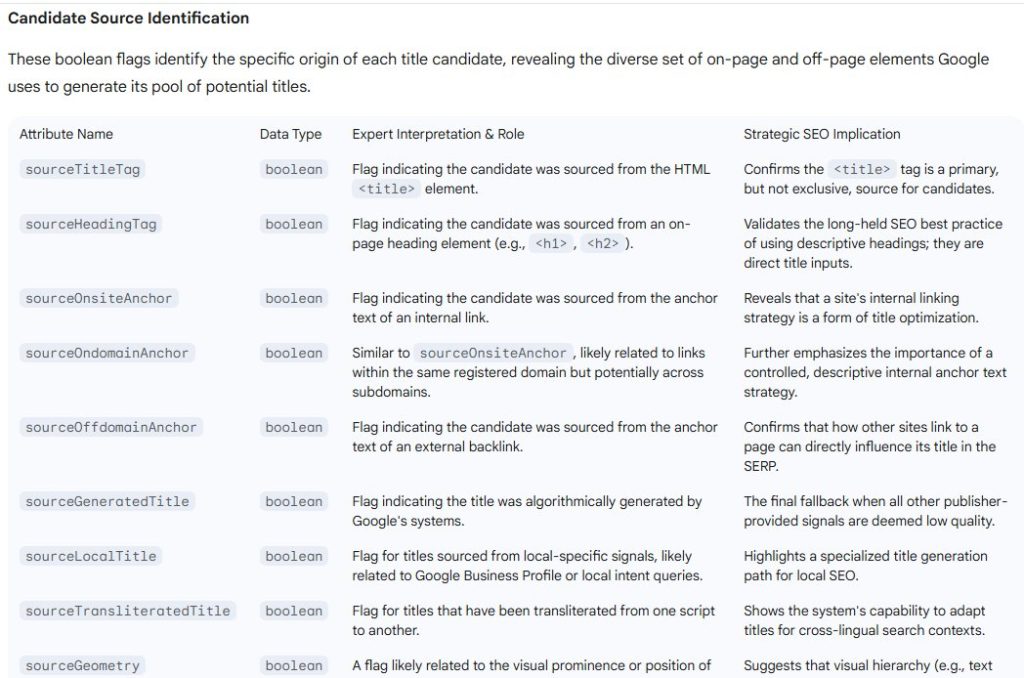
The leak outlines how Google may score multiple “title candidates” from a page—including the tag, H1, headings, anchor text, and body content—to decide which version appears in search results.
Referenced attributes include:
While the documents suggest these elements sit inside Google’s SAFT NLP (Semantic Annotation Framework and Tooling)—used to understand and label content rather than directly rank pages—the system appears to influence which titles and snippets qualify for display.
Industry takeaway:
Even if Goldmine isn’t a direct ranking algorithm, it impacts how Google interprets and presents content. Consistency between your title tag, H1, and on-page headings will likely improve how your content is represented in search.
Google officially announced new AI-powered previews for Discover along with an enhanced sports feed in mobile search.
Key updates:
What this means for SEO:
The opening lines of your content now double as preview text—make them clear, engaging, and context-rich.
As you see the SEO news today, the search industry continued its steady pivot toward AI-first experiences. From Google’s experiments with generative snippets to Perplexity’s publisher-focused model, the landscape is clearly evolving. Here’s a concise breakdown of the week’s most important search engine news updates.
Google began testing AI-generated meta descriptions across selected results. These Gemini-written snippets—marked by a small AI icon that appeared prominently on Reddit and news domains. The move signals a deeper shift in how Google interprets and displays information, where content semantics may soon outweigh traditional metadata.
In addition, Google rolled out new interface experiments including a “Show more” button that jumps users directly into AI Mode, an “Ask AI Mode anything” carousel that encourages discovery, and italicized citations in AI answers for improved readability.
Behind the scenes, voice search received a major upgrade. Google’s new Speech-to-Retrieval (S2R) model now processes spoken queries directly into search intent rather than text resulting in faster and more accurate responses. Analysts also reported notable ranking volatility around October 7–8, likely tied to post-update recalibrations following the October 3 serving incident.
Bing introduced a new “History” label that informs users when search results are influenced by their previous activity, part of its transparency initiative. A redesigned Bing Places for Business dashboard also rolled out globally, simplifying profile management and insights for local businesses.
Meanwhile, Perplexity AI paused new advertising programs to focus on its publisher revenue-sharing model, now offering creators up to 80% of subscription revenue when their content appears in AI-generated answers. This reflects a clear pivot toward trust, citation accuracy, and publisher collaboration over ad saturation.
Toolmakers are responding fast to the generative search shift. Yoast AI Brand Insights (Beta) launched a dashboard tracking brand visibility within AI engines like ChatGPT, Gemini, and Perplexity, measuring mentions, sentiment, and citation frequency under a single “AI Visibility Index.”
Surfer SEO followed with a major update introducing an AI Tracker Dashboard, “Brand Knowledge” modules for context-aware AI writing, and real-time optimization alerts. These developments are reshaping how SEOs quantify brand presence beyond traditional rankings.
At the reporting layer, analysts are blending GA4, GSC, and Looker Studio to annotate data around AI results, volatility, and impression dips, turning standard analytics into adaptive, AI-informed visibility tracking systems.
The latest SEO news updates October 2025 confirmed that search visibility now extends far beyond blue links. SEOs are beginning to measure how brands appear in AI summaries, conversational responses, and voice-driven results. The focus is shifting from ranking to representation.
In practice, that means strengthening entity consistency, auditing structured data, and tracking brand mentions inside AI platforms. As Google, Bing, and Perplexity redefine discovery through AI, visibility becomes a multi-surface challenge one that rewards clarity, credibility, and adaptability.
Google’s Search Status Dashboard shows an ongoing Serving issue beginning Oct 3, 2025 (13:00 PDT). If you saw odd blips around that date, document and move on — don’t mistake outages for algorithm shifts. Third-party coverage echoed Google’s “data center issue” explanation and advised against knee-jerk changes. Add an annotation in your analytics. Google Search Status
Google confirmed that the results-per-page parameter is not supported, ending a decade-plus workaround many tools relied on. The ripple effects: messy rank tracking, GSC impressions drops that reflect counting changes more than real visibility loss, and a short-term wave of “my traffic broke” confusion. Treat September 12–20 as a new baseline and recalibrate your tooling. For synthesis and on-the-ground analysis, see Search Engine Land’s confirmation, Found’s data read, and Brodie Clark’s forensic write-up. Search Engine Land
Google expanded AI Mode to Hindi, Indonesian, Japanese, Korean, and Brazilian Portuguese, elevating India/APAC priority for native-language content. In parallel, Google launched Search Live in the U.S. — a voice-first, camera-aware experience that converses and cites links in real time, without Labs opt-in. Expect more multimodal queries and AI answers with visual elements sitting above or beside traditional results. blog.google
Perplexity’s Comet AI browser moved from premium/waitlist to free for everyone, positioning itself as a daily driver with baked-in assistant features. OpenAI switched on Instant Checkout in ChatGPT with Etsy live and Shopify “coming soon,” teeing up a search-less path from discovery to purchase. Brave added detailed AI answers directly in results, tightening its challenger stance against Google. If your strategy still treats Google as the only front door, October says: diversify. The Verge
AI Mode is explicitly designed to reason across the web and provide linked answers you can probe with follow-ups. That rewards pages that are (a) extractable, (b) trustworthy, and (c) clearly structured with entities and schema. Google’s recent product posts also emphasize more visual exploration inside AI Mode, blending conversational queries with shoppable and image-rich results. Translation: optimize for scannable clarity and multimodal context, not just text blocks. blog.google
Tactical checklist:
With Search Live, users can talk to Search and show it problems via the camera, then receive AI-generated guidance plus links. For local, home/DIY, travel, fashion, and troubleshooting, this short-circuits generic listicles. Invest in helpful visuals, short clips, and annotated images that AIs can reference — and keep Google Business Profile and product feeds immaculate for citations and shopping modules. blog.google
AI Mode’s Hindi support makes Indian audiences a priority for native-language hubs (not blind translation). Meanwhile, EU rollouts remain more cautious due to regulatory constraints; take the breathing room to harden quality, speed, and transparent sourcing that will be table stakes as AI answers expand. blog.google
Workflows that once took a dev now take a template:
ingest GSC → cluster with NLP → brief drafts → QA diffs → publish and log.
The biggest gains come from fewer manual hops and faster iteration cycles — and they’re resilient to SERP volatility caused by AI overlays and parameter removals.
Teams are rolling internal copilots that merge inventory, CRM, CMS, and demand data to propose conversion-aligned content. Microsoft’s evangelism this year has repeatedly underlined AI search blending chat, anticipation, and smarter indexing; the signal for SEOs is to supply clean entity data and fresh feeds a model can trust. Bing Blogs
Blend GA4 + GSC + server logs and annotate Sept 12–20 (&num=100 fallout) and Oct 3 (Serving incident). Expect impressions and average position to look different post-September; orient stakeholders to a new baseline and track AI answer appearances where available (Bing Webmaster, third-party SGE trackers, and your own SERP scrapes). Search Engine Land
Add a portable, source-aware summary above the fold for your primary intent. Use short sentences, cite internal anchors or authoritative external sources, and ensure the section is machine-parsable (clean markup, not inside accordion JS). Measure downstream with annotations around Sept/Oct changes. blog.google
Ship list (2 hours):
Run entity extraction on your top URLs, pick 2–3 high-salience entities each, and add contextual links from semantically close pages. This reinforces topical clusters AIs use to justify citations and helps classic crawling. (Bonus: add short glossary stubs.)
Spend 60 minutes in AI Mode, Bing chat, and Brave detailed answers for your core topics. Log which formats and domains get cited. If Reddit/forums dominate in YMYL queries, augment your first-hand experience and visuals, then participate in relevant communities. blog.google
Create a pre/post comparison dashboard with toggles for before Sept 12 and after Sept 20. Expect impressions to drop more than clicks (counting change), and avg. position to skew better. Socialize the methodology and avoid performance whiplash in Q4 reviews. Found
With Instant Checkout live in ChatGPT for U.S. Etsy sellers (Shopify next), journeys will sometimes skip traditional SERPs. If you sell DTC, ensure product data clarity, up-to-date pricing, and frictionless fulfillment pages that assistants can reference. Reuters
&num=100 removal and impression counting changes altered trend lines. We reset baselines, not strategy. Search Engine LandOctober 2025 wasn’t about one “big update.” It was about systems changing: how results are measured, how answers are presented, and where users start tasks. The durable strategy is the same compass we’ve used through countless cycles — useful, trustworthy content on fast, structured pages — but applied to a map with new overlays: AI summaries, voice/camera sessions, and assistant-native commerce. Teams that blend discipline (process, QA, measurement) with curiosity (new interfaces, new formats) will out-iterate the market in Q4 and beyond. blog.google
Update 1: Here is an exclusive coverage of the SEO News of the Month – September 2025
Update 2: Newer editions available: Jump to November 2025 for the latest AI + SEO changes.
👉 Latest AI SEO News – November 2025
👉 Update 3: Newer editions available: Jump to Latest AI SEO News of the Month December 2025.
See you in next week’s SEO news — Manikandan N

Stay ahead of Google updates, AI search experiments, and SEO automation workflows with insights from global top SEO minds. No noise - just what matters, delivered every week.